James Ramsay
To the LighthouseJames Ramsay’s longing for the Lighthouse voyage gives an early shape to his fierce opposition to his father and, years later, to the complicated recognition between them. As a child he experiences hope and disappointment with exceptional intensity; as a young man he still resists what he regards as his father’s tyranny, but steers the boat to the Lighthouse and receives the praise he has long wanted. His story holds anger and achievement together rather than resolving one into the other.
Identity and Early Character
James is six when he first appears, sitting on the floor and cutting pictures from the Army and Navy Stores catalogue. His mother has said the family may go to the Lighthouse if the weather is fine, and to James the possibility becomes almost a certainty. Even the picture of a refrigerator acquires the glow of that anticipated happiness. The scene establishes how readily future hopes color his present: a change in prospect can fix itself in his mind with unusual force.
His inward intensity is not obvious from his appearance alone. Mrs Ramsay sees a boy with a high forehead and fierce blue eyes, sternly attentive as he guides his scissors around the printed picture. The contrast between that severity and the private imaginative world she senses in him helps define him from the outset. He is both a child absorbed in a small, exact task and a person for whom an ordinary object can become charged with expectation.
The Postponed Voyage and His Parents
Mr Ramsay interrupts the hope by declaring that the weather will not be fine. James’s response is extreme: the thought of killing his father flashes through his mind. The intensity of the reaction is not presented as a considered plan but as the measure of the anger his father’s certainty provokes. James believes Mr Ramsay takes pleasure in disappointing him and in ridiculing Mrs Ramsay, whom James considers far better than her husband. Mr Ramsay’s uncompromising commitment to facts, in James’s eyes, makes the disappointment more painful rather than more bearable.
Mrs Ramsay tries to keep hope alive, saying the weather may change. She is also knitting a reddish-brown stocking for the Lighthouse keeper’s son, who has a tuberculous hip; she means to send it with old magazines and tobacco. Her practical sympathy for the keeper’s isolated household exists alongside her effort to comfort James. When Mr Ramsay again insists there is no chance of going, she points out that the wind often changes. Mr Ramsay treats this as an irrational disregard of facts, while James’s hope has already been exposed to another blunt refusal.
The conflict is intimate as well as practical. James resents his father’s arrival when he is reading with his mother, because Mr Ramsay demands attention and sympathy and interrupts the closeness James values. He watches Mrs Ramsay’s attention shift toward her husband and tries, by keeping his eyes on the page and pointing to a word, to draw it back. For James, the threatened voyage and the intrusion into this shared reading are part of the same emotional pattern: his father’s presence can displace both hope and maternal attention.
Childhood Fears and Private Alliances
The boar’s skull in the nursery becomes another occasion for Mrs Ramsay’s care. When Cam cannot sleep because of it, Mrs Ramsay covers it with her own shawl and invents a soothing transformation, describing the covered object as a mountain, a nest, and a garden. Once Cam is asleep, James asks whether they will go to the Lighthouse the next day. Mrs Ramsay says not tomorrow but promises the next fine day. She knows she has raised his hopes and feels angry with herself, as well as with Mr Ramsay and Charles Tansley, for the disappointment and uncertainty surrounding the promise.
The scene makes James’s need for reassurance distinct from the larger household’s talk of weather. He asks again even after the day’s dispute, and the answer is necessarily a promise rather than certainty. Mrs Ramsay covers him and leaves the room, while the Lighthouse remains for him both a desired destination and a hope vulnerable to other people’s decisions.
The Voyage and Resistance
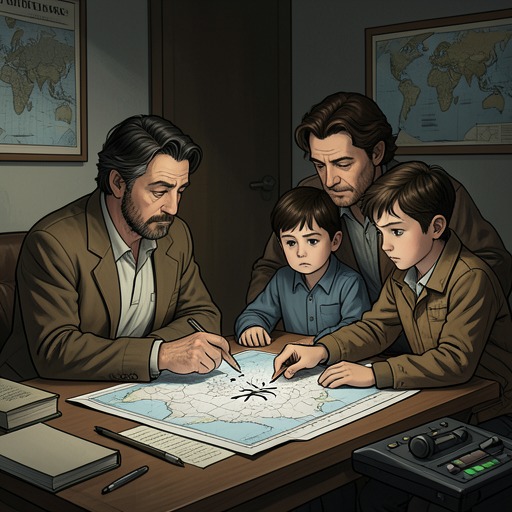
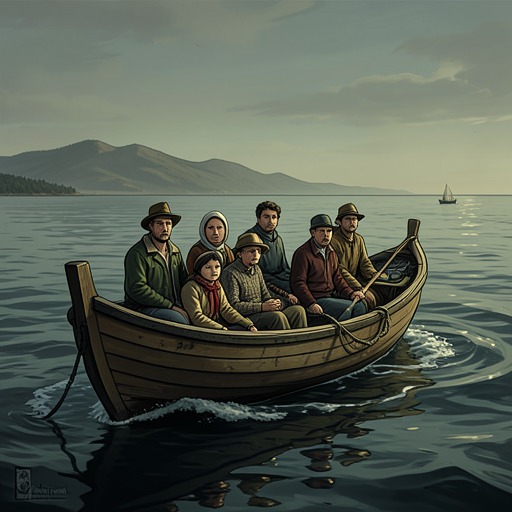
Years later, James is in the boat with Mr Ramsay and Cam. James steers, Cam sits in the bow, and their father occupies the middle. The boat initially lies still, its sail slack in the calm. Mr Ramsay grows impatient and tells Macalister’s boy to row. James and Cam have been made to come against their wishes; during the walk to the beach they silently formed a compact to resist what they experience as their father’s tyranny. Their opposition is now expressed through silence and the wish that the expedition will fail, not through the childhood fantasy of a weapon.
The calm gives James’s resentment room to return. As Mr Ramsay reads from a small book, James interprets each turn of the page as a gesture directed at him and dreads the next sharp remark. His old image of striking his father with a knife persists, but he begins to distinguish the man before him from the larger force he calls tyranny: the power to command people to do what they do not want and to deny them the right to speak. That distinction does not make him reconciled. It shows that his resistance has acquired a political and moral language, even as the immediate conflict remains between father and son in the boat.
Recognition and Narrative Significance
The voyage changes when James steers the boat successfully. Mr Ramsay tells him, “Well done!” Cam understands that this is the praise James has wanted. James sits upright, pleased but guarding his pleasure, and does not look toward either parent. The recognition matters precisely because it comes from the father whose judgment has so often seemed to diminish him; James receives it without turning the moment into easy reconciliation.
James’s trajectory connects childhood hope to adult resistance and accomplishment. The boy who once saw a refrigerator in a catalogue as radiant with the prospect of reaching the Lighthouse becomes the young man whose steering helps carry the party there. Yet the journey does not erase the earlier postponement or the strained relationship. The praise offers a real, sharply felt change within that history: James’s competence is acknowledged by Mr Ramsay, while James retains the independence and reserve with which he has learned to protect himself.